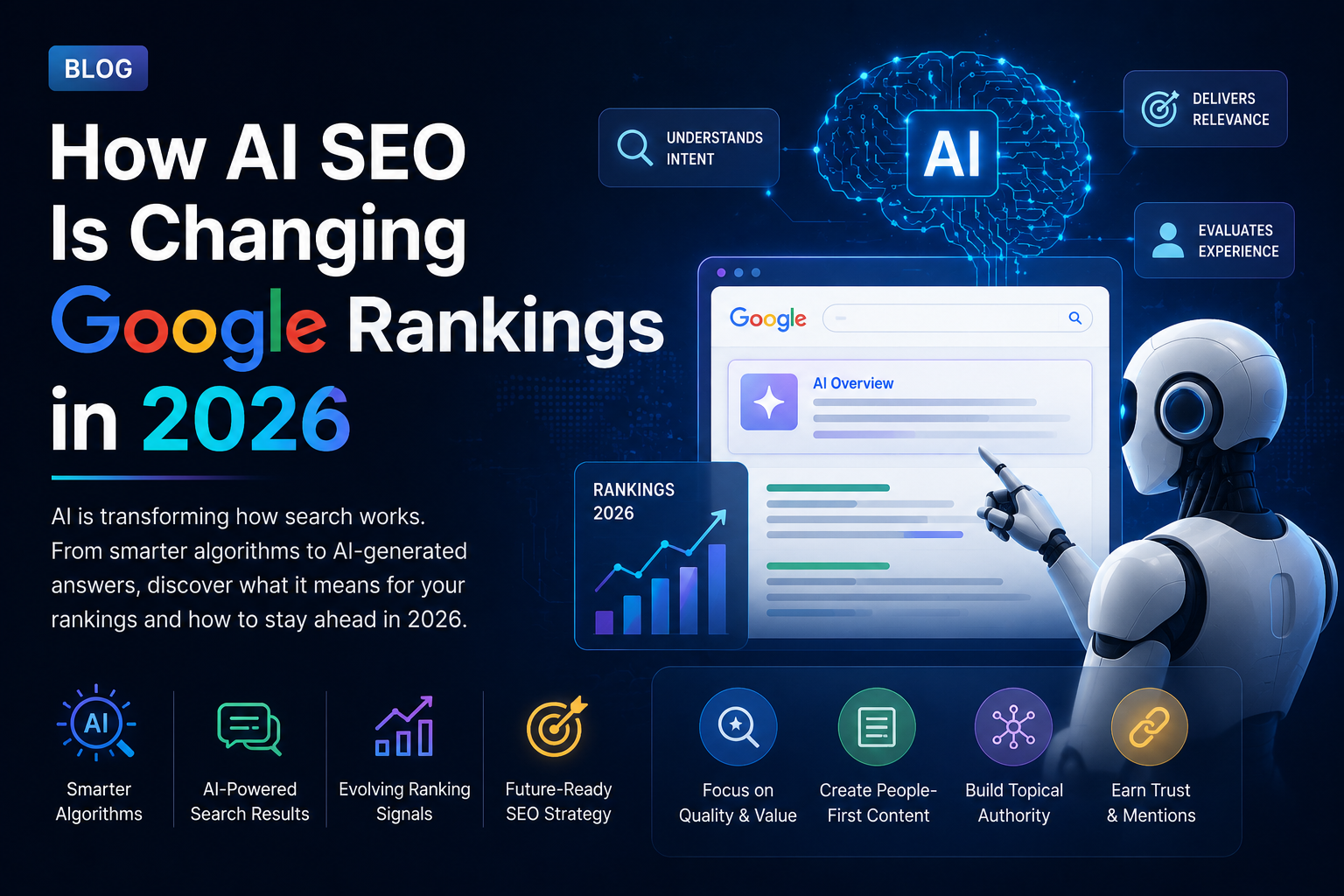
Google Search has evolved significantly over the past few years, and 2026 marks one of the biggest shifts yet. With the rise of AI-powered search experiences, Google’s ranking system is no longer focused solely on keywords and backlinks. Instead, it prioritizes content that demonstrates expertise, answers user intent, and provides genuine value.
Features like AI Overviews, conversational search, and multimodal search are changing how users interact with search results. Businesses that continue to rely only on traditional SEO techniques may find it harder to maintain visibility, while those adopting AI SEO strategies are better positioned for long-term success.
At Digitalverse Technologies, we help businesses stay ahead of these changes by combining traditional SEO with modern AI optimization techniques. This guide explores how AI SEO is reshaping Google rankings in 2026 and what you can do to stay competitive.
What Is AI SEO?
AI SEO is the process of optimizing content so it performs well in both traditional search results and AI-powered search experiences.
Unlike conventional SEO, AI SEO focuses on creating content that artificial intelligence can easily understand, summarize, and reference.
An effective AI SEO strategy combines:
- Search Engine Optimization (SEO)
- Answer Engine Optimization (AEO)
- Generative Engine Optimization (GEO)
- Semantic SEO
- Entity Optimization
- E-E-A-T principles
- Structured data
Together, these practices help websites remain visible across Google’s evolving search ecosystem.
Why Google Rankings Are Changing
Google’s mission has always been to deliver the most helpful information to users. AI enables Google to better understand search intent, context, and relationships between topics.
Instead of matching pages based only on keywords, Google’s AI evaluates:
- Content quality
- User intent
- Expertise
- Context
- Topic relationships
- Trust signals
- Website experience
This means businesses must focus on providing complete and accurate answers rather than simply targeting keywords.
AI Overviews Are Transforming Search
One of the biggest changes is the introduction of AI-generated summaries at the top of many search results.
Instead of displaying only a list of links, Google now generates comprehensive answers using information gathered from trusted sources.
To increase the chances of appearing in AI Overviews, websites should:
- Publish accurate information.
- Answer user questions directly.
- Organize content with clear headings.
- Use structured data.
- Demonstrate expertise through original insights.
Content that is easy for AI to understand has a better chance of being referenced.
Keywords Alone Are No Longer Enough
Traditional SEO emphasized keyword density and exact-match phrases.
In 2026, Google understands natural language much more effectively.
Rather than repeating the same keyword multiple times, focus on covering the topic comprehensively.
For example, an article about AI SEO should naturally include related concepts such as:
- AI search
- Semantic SEO
- Entity optimization
- Search intent
- AI Overviews
- Structured data
- User experience
- EEAT
This creates richer content that aligns with how AI interprets language.
Search Intent Is More Important Than Ever
Google increasingly ranks content that fully satisfies user intent.
There are four common search intents:
Informational
Users want to learn something.
Example:
How does AI SEO work?
Navigational
Users are looking for a specific website or brand.
Commercial
Users are comparing products or services before making a decision.
Transactional
Users are ready to take action, such as purchasing or requesting a quote.
Understanding intent helps create content that meets user expectations.
EEAT Continues to Influence Rankings
Google places strong emphasis on Experience, Expertise, Authoritativeness, and Trustworthiness.
Websites should strengthen EEAT by:
- Publishing expert-written content.
- Displaying author credentials.
- Sharing case studies.
- Including customer testimonials.
- Keeping content updated.
- Providing accurate contact information.
These trust signals help both users and AI systems evaluate credibility.
Structured Data Supports AI Understanding
Schema markup helps Google interpret your content more accurately.
Useful schema types include:
- Article
- FAQ
- Organization
- Service
- Breadcrumb
- Local Business
- Person
Although schema is not a direct ranking factor, it improves content understanding and can enhance search visibility.
Entity SEO Is Becoming Essential
AI identifies entities rather than relying only on keywords.
Entities include:
- People
- Companies
- Products
- Locations
- Services
- Technologies
Building clear relationships between entities helps Google understand your expertise and improves topical relevance.
User Experience Remains a Ranking Signal
AI-powered search still values positive user experiences.
Focus on:
- Fast loading pages
- Mobile-friendly design
- Easy navigation
- Accessible content
- Secure HTTPS connections
- Readable formatting
A great user experience encourages visitors to stay longer and engage with your content.
High-Quality Content Wins
Google’s AI favors original, valuable content over repetitive or low-quality articles.
Successful content should:
- Solve real problems.
- Include practical examples.
- Be easy to read.
- Cover topics comprehensively.
- Reflect current information.
- Demonstrate first-hand knowledge whenever possible.
Publishing fewer high-quality articles often delivers better results than producing large volumes of generic content.
Internal Linking Builds Context
Internal links help Google understand relationships between pages.
For example, an AI SEO guide can naturally connect to articles about:
- Structured data
- Technical SEO
- Local SEO
- Content marketing
- Google AI Overviews
- Entity optimization
Strong internal linking strengthens topical authority and improves crawling.
Backlinks Still Matter
While AI has changed many aspects of search, quality backlinks remain an important trust signal.
Earn backlinks by:
- Publishing original research.
- Creating comprehensive guides.
- Sharing industry insights.
- Writing guest articles.
- Building relationships with reputable websites.
Focus on relevance and quality rather than quantity.
Voice and Conversational Search Are Growing
More users now interact with Google using natural language.
Instead of typing:
AI SEO tools
They ask:
What are the best AI SEO tools for improving Google rankings?
Content written in a conversational style is easier for AI to understand and present in search results.
How Businesses Should Adapt
Businesses preparing for the future should:
- Create helpful, user-first content.
- Optimize for search intent.
- Use structured data.
- Build topical authority.
- Strengthen EEAT signals.
- Improve page speed.
- Focus on semantic search.
- Update content regularly.
- Monitor AI search trends.
- Optimize for conversational queries.
Combining these strategies creates a strong foundation for sustainable rankings.
Common Mistakes to Avoid
Avoid practices that can reduce visibility:
- Keyword stuffing
- Thin AI-generated content with little human oversight
- Publishing outdated information
- Ignoring mobile optimization
- Weak internal linking
- Missing schema markup
- Poor website performance
- Duplicate content
- Low-quality backlinks
A user-focused approach consistently delivers better long-term results.
The Future of Google Rankings
Google’s search experience will continue to evolve as AI becomes more sophisticated.
Future ranking systems are expected to place even greater emphasis on:
- Helpful content
- Expertise
- Brand authority
- Entity relationships
- Semantic relevance
- User satisfaction
Businesses that embrace these principles today will be better prepared for tomorrow’s search landscape.
Final Thoughts
AI SEO is not replacing traditional SEO. It is expanding it.
Success in 2026 depends on combining technical SEO, high-quality content, structured data, entity optimization, and user-focused experiences into one comprehensive strategy.
Businesses that understand how AI interprets content and aligns with user intent will have the best opportunity to improve rankings and remain competitive.
At Digitalverse Technologies, we help organizations implement future-ready SEO strategies that improve visibility across Google Search, AI Overviews, and emerging AI-powered search platforms.
Frequently Asked Questions
1. What is AI SEO?
AI SEO is the practice of optimizing websites for both traditional search engines and AI-powered search experiences by combining SEO, AEO, GEO, semantic optimization, and structured data.
2. How is AI changing Google rankings?
Google’s AI now evaluates content based on user intent, expertise, context, and quality rather than relying primarily on keyword matching.
3. Does traditional SEO still matter in 2026?
Yes. Technical SEO, quality content, backlinks, and website performance remain important, but they should be combined with AI-focused optimization strategies.
4. What role does structured data play in AI SEO?
Structured data helps Google and AI systems better understand webpage content, improving indexing, rich results, and the potential for inclusion in AI-generated responses.
5. How can businesses prepare for AI-powered search?
Businesses should publish authoritative content, optimize for search intent, implement schema markup, strengthen EEAT, build topical authority, improve user experience, and regularly update their content to reflect current trends.