Artificial intelligence is transforming how people search for information online. Instead of browsing multiple search results, users increasingly rely on AI-powered platforms like ChatGPT, Gemini, Perplexity, and Google’s AI Overviews to receive direct, summarized answers.
This shift means that creating quality content is only part of the equation. Search engines and AI models also need to understand your content accurately. That’s where structured data, schema markup, and entities play a vital role.
At Digitalverse Technologies, we help businesses prepare for the future of search by implementing modern AI SEO strategies. In this guide, you’ll learn why structured data matters, how schema markup works, and why entities have become one of the most important ranking signals for AI-driven search.
What Is Structured Data?
Structured data is a standardized format that provides additional information about your webpage to search engines.
Instead of asking search engines to interpret content on their own, structured data clearly explains what each section of a page represents.
For example, structured data can identify:
- A business
- A product
- An article
- An event
- A review
- A recipe
- A frequently asked question
- An author
- A service
This additional context helps search engines and AI systems understand your content more accurately.
What Is Schema Markup?
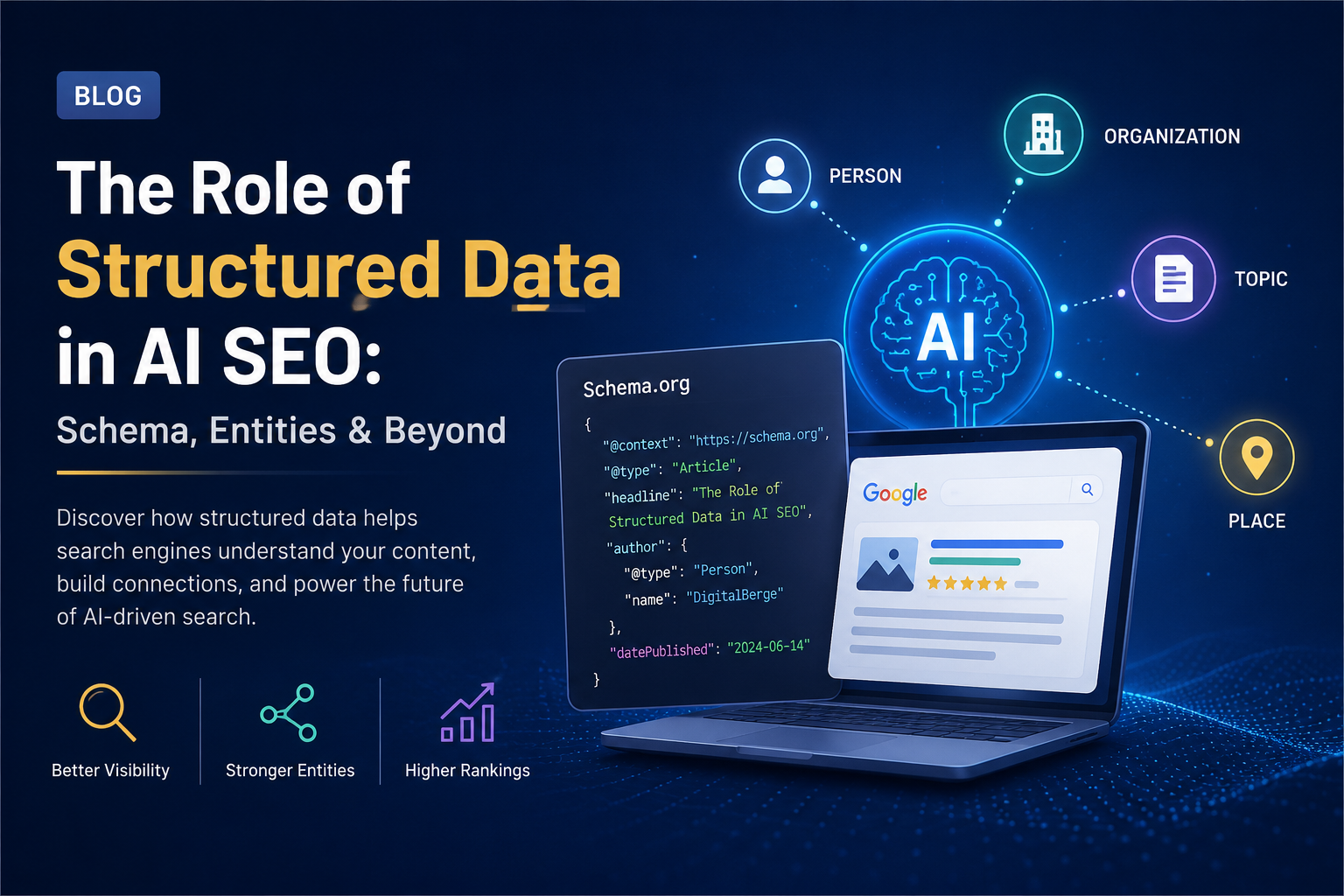
Schema markup is the code used to implement structured data on a website.
It follows the vocabulary provided by Schema.org and is typically written in JSON-LD format.
Schema markup tells search engines exactly what your content represents instead of leaving it open to interpretation.
For example, an article schema identifies:
- Headline
- Author
- Publication date
- Publisher
- Featured image
- Description
This improves how your content is interpreted across search engines and AI-powered platforms.
What Are Entities in AI SEO?
An entity is a uniquely identifiable person, place, organization, product, event, or concept.
Unlike keywords, entities help AI understand meaning and relationships.
For example, the term “Apple” could refer to:
- Apple Inc.
- The fruit
- A music label
AI uses entities and context to determine the correct meaning.
Entity optimization helps search engines connect your content with recognized knowledge graphs, improving relevance and trust.
Why Structured Data Matters for AI Search
Traditional search engines relied heavily on keywords.
AI search engines focus on understanding relationships, intent, and context.
Structured data helps AI:
- Understand page content
- Identify important entities
- Connect related topics
- Verify factual information
- Generate accurate summaries
- Display rich search results
Without structured data, AI may have difficulty interpreting complex information correctly.
Benefits of Structured Data for AI SEO
Better Content Understanding
Schema markup removes ambiguity by explaining what each page contains.
This improves indexing and interpretation.
Higher Visibility in Search Results
Structured data enables rich results such as:
- FAQs
- Reviews
- Star ratings
- Product details
- Breadcrumbs
- Images
- Event information
Rich results attract more clicks and improve user engagement.
Improved AI Citations
AI assistants often rely on trusted and well-structured sources.
Pages with clear schema and authoritative entities have a better chance of being referenced in AI-generated responses.
Stronger Topical Authority
When multiple pages are properly connected using structured data and internal links, search engines better understand your expertise.
This contributes to stronger topical authority.
Enhanced User Experience
Structured information helps users quickly find answers.
This reduces confusion and improves satisfaction.
Essential Schema Types for AI SEO
Article Schema
Ideal for blogs, news articles, and educational content.
Helps AI understand the page’s primary topic.
Organization Schema
Provides details about your business, including:
- Company name
- Logo
- Website
- Contact information
- Social profiles
This strengthens brand recognition.
FAQ Schema
FAQ schema highlights commonly asked questions and concise answers.
It improves visibility for conversational searches and AI-generated summaries.
Local Business Schema
Perfect for businesses serving specific locations.
It includes:
- Business name
- Address
- Phone number
- Opening hours
- Geographic location
This supports local SEO and AI search.
Service Schema
Ideal for agencies and service providers.
Clearly defines the services offered on your website.
Breadcrumb Schema
Helps search engines understand the structure of your website.
It also improves user navigation.
Person Schema
Useful for author pages and leadership profiles.
It strengthens credibility and supports Google’s Experience, Expertise, Authoritativeness, and Trustworthiness (EEAT) principles.
Entity Optimization Best Practices
Entity optimization goes beyond adding keywords.
Follow these best practices:
Build Comprehensive Topic Clusters
Create multiple related articles covering different aspects of the same topic.
This helps AI understand your expertise.
Maintain Consistent Brand Information
Ensure your company name, logo, contact details, and descriptions remain consistent across:
- Website
- Google Business Profile
- Social media
- Business directories
Consistency builds trust.
Use Internal Linking
Connect related content naturally.
Internal links establish relationships between entities and improve crawlability.
Reference Trusted Sources
Citing authoritative sources increases credibility and supports factual accuracy.
Create Author Profiles
Detailed author pages with credentials help strengthen EEAT signals.
AI platforms value identifiable experts.
Common Structured Data Mistakes
Avoid these common errors:
- Using outdated schema types
- Adding incorrect markup
- Missing required properties
- Duplicate schema
- Broken JSON-LD code
- Using schema that does not match page content
- Forgetting to update structured data after content changes
Regular audits help maintain accuracy.
Structured Data and Google’s AI Overviews
Google’s AI Overviews rely on multiple signals to generate responses.
Structured data contributes by helping Google:
- Understand page context
- Identify entities
- Recognize expertise
- Organize information efficiently
Although schema alone does not guarantee inclusion, it improves overall content understanding.
Beyond Schema: The Future of AI SEO
AI SEO extends beyond structured data.
Businesses should also focus on:
- High-quality original content
- Conversational writing
- EEAT principles
- Semantic search optimization
- Natural language processing
- User intent
- Fast-loading websites
- Mobile optimization
- Accessibility
- Continuous content updates
The combination of these elements creates a strong foundation for future AI search visibility.
Best Practices Checklist
Use this checklist when optimizing your website:
- Add appropriate schema markup to every important page.
- Implement Organization and Local Business schema.
- Use FAQ schema where relevant.
- Create detailed author profiles.
- Build topic clusters around your core services.
- Improve internal linking.
- Keep structured data updated.
- Optimize for user intent instead of keywords alone.
- Publish original, expert-driven content.
- Regularly test schema implementation using validation tools.
Final Thoughts
Structured data has evolved from an optional SEO enhancement into an essential component of AI search optimization.
As AI-powered search continues to grow, websites that clearly communicate their content through schema markup and entity optimization will have a significant advantage.
Success in 2026 requires more than ranking for keywords. It requires helping AI understand your business, your expertise, and the relationships between your content.
At Digitalverse Technologies, we help businesses implement advanced SEO, AI SEO, schema markup, and entity optimization strategies that improve visibility across Google Search, AI Overviews, ChatGPT, Gemini, and other emerging AI search platforms.
Frequently Asked Questions
1. What is structured data in AI SEO?
Structured data is standardized code that helps search engines and AI systems understand the content and purpose of a webpage more accurately.
2. Is schema markup important for AI search?
Yes. Schema markup provides clear context about your content, making it easier for search engines and AI platforms to interpret and present accurate information.
3. What are entities in SEO?
Entities are uniquely identifiable people, organizations, places, products, or concepts that help search engines understand meaning and relationships beyond keywords.
4. Which schema types are most useful for business websites?
Organization, Article, FAQ, Service, Local Business, Breadcrumb, and Person schema are among the most valuable for improving search visibility and AI understanding.
5. Does structured data improve Google rankings?
Structured data is not a direct ranking factor, but it helps search engines better understand your content, supports rich results, enhances visibility, and can improve click-through rates, all of which contribute to stronger overall SEO performance.