Search is changing faster than ever. For years, businesses focused primarily on ranking their websites on Google for relevant keywords. While traditional SEO remains important, the search experience in 2026 has expanded far beyond the familiar list of blue links.
Users can now receive AI-generated answers through experiences such as Google AI Overviews, Google AI Mode, Microsoft Copilot, and other AI-powered search platforms. Instead of simply presenting webpages, these systems interpret queries, retrieve information, summarize content, and provide direct answers.
This has created a new visibility goal for businesses: being discovered, mentioned, and cited by AI search systems.
So, what actually matters beyond traditional Google rankings in 2026? Let’s explore the key AI search ranking factors businesses should focus on.
What Is AI Search?
AI search uses artificial intelligence to understand the meaning and context behind a user’s query and provide a conversational or synthesized response.
Traditional search generally works around a simple journey:
Query → Search results → Website → Answer
AI search can make the journey more direct:
Query → AI interpretation → Synthesized answer → Sources and citations
Google explains that its AI search experiences still rely on core Search ranking and quality systems to retrieve relevant and up-to-date information.
This means businesses should not abandon traditional SEO. Instead, they need to expand their strategy to make their content useful for both conventional search results and AI-generated answers.
Key AI Search Ranking Factors in 2026
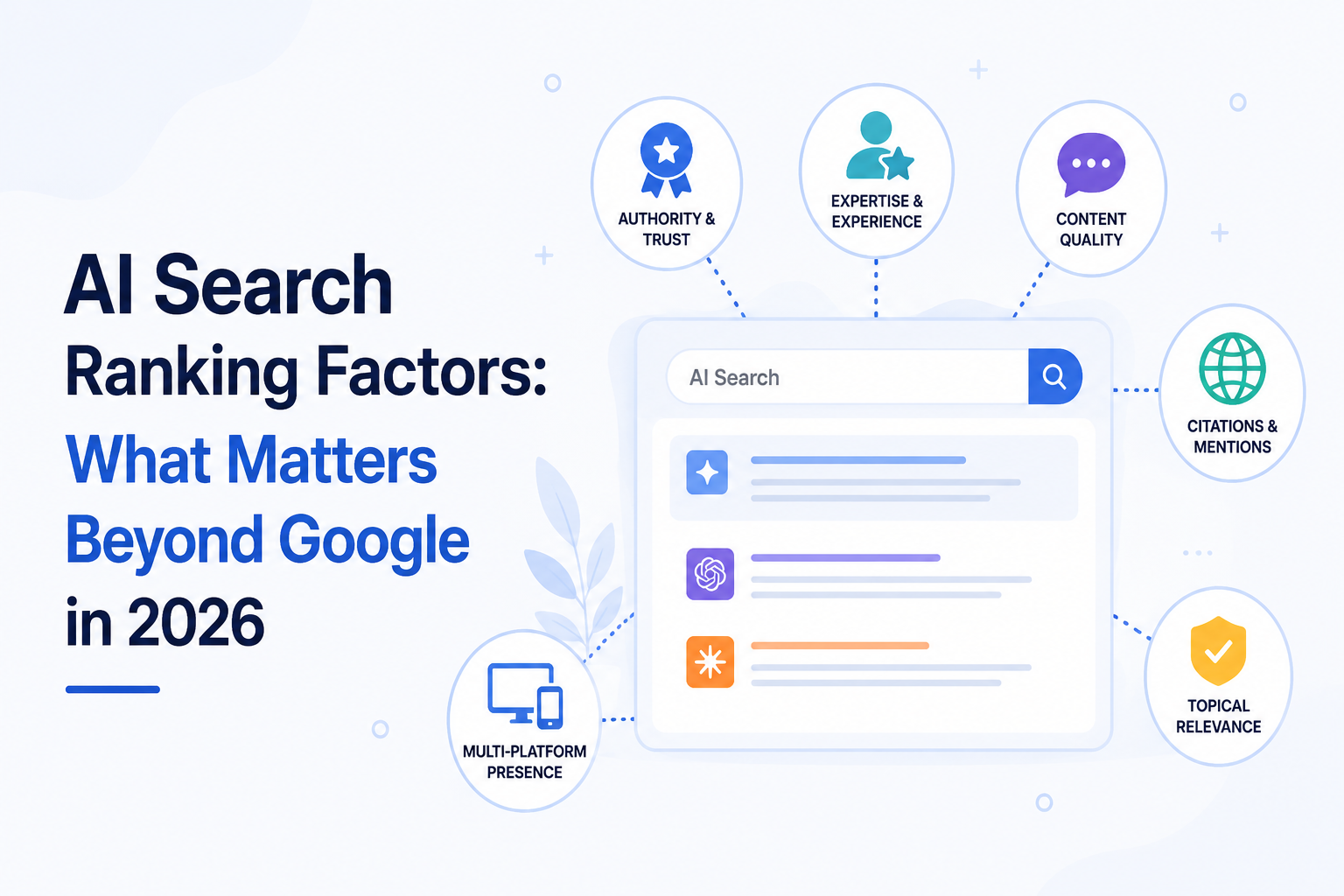
1. Content Quality and Original Value
High-quality content remains one of the most important factors in AI search visibility.
AI systems have access to enormous amounts of information, so simply publishing another generic article about a common topic is unlikely to provide much competitive value.
Content should offer something useful, such as:
- Original research
- Expert insights
- Real examples
- Unique data
- First-hand experiences
- Clear explanations
- Practical solutions
- Updated information
Google’s guidance for AI search emphasizes creating unique, satisfying content that provides genuine value to visitors rather than content produced primarily for search rankings.
2. Topical Authority
AI search systems need reliable information to answer complex questions.
This makes topical authority increasingly important.
Instead of publishing isolated articles around unrelated keywords, businesses should build comprehensive topic clusters.
For example, a digital marketing company could create connected content around:
- SEO
- Technical SEO
- Local SEO
- AI SEO
- Generative Engine Optimization
- Content marketing
- Answer Engine Optimization
Supporting articles connected through internal links help demonstrate broader expertise around a subject.
3. Clear and Structured Content
AI systems need to understand content before they can potentially retrieve or cite it.
Well-structured content makes information easier to interpret.
Use:
- Descriptive H2 and H3 headings
- Short paragraphs
- Bullet points
- Numbered steps
- Tables where appropriate
- Direct answers
- Clear definitions
- Relevant FAQs
For example, instead of writing a long paragraph explaining a concept, provide a clear question-based heading followed by a concise answer and supporting explanation.
This structure can make important information easier for both users and search systems to identify.
4. Entity and Brand Authority
AI search is increasingly focused on entities, not just keywords.
An entity could be a:
- Company
- Person
- Product
- Service
- Organization
- Location
- Topic
Search systems can connect information from different sources to understand what an entity represents.
For businesses, this means maintaining consistent information across the web matters.
Your brand information should be accurate and consistent across:
- Your website
- Business profiles
- Industry directories
- Social platforms
- Review websites
- News publications
- Professional profiles
The goal is to build a strong and consistent digital identity that AI systems can understand.
5. Trustworthy Sources and Citations
AI-generated answers need reliable sources to support the information they provide.
Bing’s 2026 AI Performance feature specifically provides publishers with insights into how often their pages are cited in AI-generated answers and which URLs are being referenced.
This highlights an important shift: visibility is no longer only about ranking; it is also about becoming a source.
Businesses should therefore strengthen their authority through:
- Original research
- Expert commentary
- Authoritative references
- Industry publications
- High-quality backlinks
- Accurate factual information
- Transparent authorship
Being referenced by credible third-party sources can help strengthen a brand’s overall digital footprint.
6. Freshness and Content Updates
AI search can be particularly useful for queries where information changes frequently.
Pricing, regulations, product specifications, industry trends, statistics, software features, and business information can become outdated quickly.
Regular content updates can help businesses maintain relevance.
A practical content maintenance process includes:
- Reviewing important pages regularly
- Updating outdated statistics
- Replacing obsolete information
- Adding recent examples
- Improving weak sections
- Checking broken links
- Reviewing search intent
Freshness should not mean changing content simply to make it look new. Updates should add genuine value.
7. Direct Answers to User Questions
AI search is conversational, so content should address questions directly.
Instead of focusing only on short keywords such as “SEO services,” consider the questions users may ask:
- How does SEO improve website visibility?
- What is AI-powered SEO?
- How does Generative Engine Optimization work?
- How can businesses appear in AI search results?
Create content that answers these questions clearly before providing deeper explanations.
This approach also supports Answer Engine Optimization, where the goal is to make information easy for answer-focused systems to understand and use.
8. Technical SEO Still Matters
Going beyond Google does not mean ignoring technical SEO.
AI systems still need to discover, crawl, interpret, and retrieve website content.
Important technical foundations include:
- Crawlability
- Indexability
- Mobile usability
- Page speed
- Internal linking
- XML sitemaps
- Canonicalization
- Structured data
- Secure HTTPS implementation
Google’s current guidance specifically states that established SEO best practices continue to be relevant for its generative AI search features.
Technical SEO therefore remains the foundation of an AI-search strategy.
9. Structured Data and Machine-Readable Information
Structured data can help search engines understand specific information about webpages and entities.
Depending on the website, businesses may use relevant structured data for:
- Organizations
- Articles
- Products
- Services
- Events
- FAQs
- Local businesses
- Reviews
Structured data should accurately represent the visible content on the page. It should not be used simply to manipulate search visibility.
10. Mentions Beyond Your Own Website
One of the biggest changes in AI search is that your website is not the only source that influences your digital presence.
AI systems may encounter information about a business across multiple online sources.
That makes third-party visibility increasingly valuable.
Businesses should consider building genuine mentions through:
- Industry websites
- Digital PR
- Expert interviews
- Guest contributions
- Relevant directories
- Customer reviews
- Community discussions
- Research publications
The objective is not to create artificial mentions everywhere. It is to establish a credible presence across relevant parts of the web.
AI Search vs Traditional SEO: What Has Changed?
Traditional SEO primarily focuses on metrics such as:
Keywords → Rankings → Traffic → Conversions
AI search introduces additional considerations:
Content → Retrieval → Citations → Brand Mentions → AI Visibility → Conversions
This does not mean rankings have become irrelevant.
Instead, SEO is expanding.
Google itself states that its generative AI search experiences are grounded in its existing Search systems, while Bing’s new AI Performance reporting demonstrates the growing importance of citations and AI visibility.
How Businesses Can Prepare for AI Search in 2026
A strong AI-search strategy should combine traditional SEO with Generative Engine Optimization.
Businesses can start by:
- Auditing existing content for quality and originality.
- Building comprehensive topic clusters.
- Improving website structure and technical SEO.
- Creating concise answers to important questions.
- Strengthening brand and entity signals.
- Earning credible third-party mentions.
- Updating outdated content regularly.
- Monitoring AI citations and brand visibility.
- Using structured data where appropriate.
- Measuring both traditional search performance and AI visibility.
Digital Verse Technologies can help businesses adapt their digital strategies to changing search behavior by combining SEO, content marketing, and emerging approaches such as Generative Engine Optimization.
Conclusion
AI search is changing what it means to be visible online.
In 2026, ranking on Google is still valuable, but it is no longer the only goal. Businesses also need to think about whether their content can be discovered, understood, trusted, referenced, and cited by AI-powered search experiences.
The strongest strategy is not to choose between traditional SEO and AI search optimization. It is to build a strategy that supports both.
By investing in original content, topical authority, technical SEO, structured information, brand credibility, third-party mentions, and Generative Engine Optimization, businesses can create a stronger foundation for visibility across the evolving search landscape.
The future of search is not simply about ranking higher. It is about becoming a trusted source that search and AI systems can confidently use.
FAQs
1. Is Google SEO still important for AI search in 2026?
Yes. Google states that its AI search experiences are built on its existing Search ranking and quality systems. Traditional SEO therefore remains an important foundation for AI visibility.
2. What is the most important AI search ranking factor?
There is no single universal ranking factor across all AI search platforms. However, high-quality original content, relevance, authority, clear structure, technical accessibility, and trustworthy information are important foundations.
3. What is Generative Engine Optimization?
Generative Engine Optimization, or GEO, focuses on improving a brand’s visibility within AI-generated answers and conversational search experiences. It goes beyond traditional keyword rankings to consider mentions, citations, retrieval, and brand representation.
4. Can backlinks still help with AI search visibility?
Yes. While AI platforms do not necessarily use identical ranking systems, authoritative third-party references can contribute to a stronger digital presence and demonstrate credibility. Businesses should focus on earning relevant, high-quality mentions rather than building links purely for volume.
5. How can I measure my AI search visibility?
Measurement is evolving. In 2026, Bing Webmaster Tools introduced AI Performance insights showing citation activity across supported AI experiences. Google has also introduced dedicated Search Console reporting for visibility within generative AI features, including AI Overviews and AI Mode, initially rolling it out to a subset of websites.